|

|

|
|
Conservation & Sustainable Use of Biodiversity in the Eastern Himalayas 
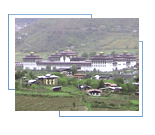
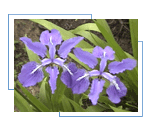
Situated high in the Himalayas and bordered only by India and China, the mountain Kingdom of Bhutan is home to some of the world's most rare and treasured species including snow leopards, blue poppies, and golden monkeys. Bhutan's natural environment ranges from some of the world's highest snow-capped peaks to steaming lowland jungles in less than a few hundred miles. Bhutan's diversity of landscapes and ecosystems harbors a dazzling array of plant and animal life. Sometimes referred to as "The Land of Medicinal Plants," Bhutan is also home to extraordinarily rich cultural traditions, and the Royal Government has prioritized environmental and cultural preservation as key components of the nation's forward-looking strategies. At the request of Bhutan's National Biodiversity Center, WFED has begun implementing an access and benefit-sharing management plan for the Royal Government of Bhutan. The management plan will position Bhutan to benefit from any valuable (commercial or scientific) discoveries that originate within Bhutan. The goal of WFED's work with Bhutan is to strengthen Bhutan's human and institutional capacity to manage bioprospecting and benefit-sharing activities for biodiversity conservation, sustainable use, and equitable sharing of benefits. Ultimately, WFED's actions aim to improve conservation and the sustainable use of Bhutan's valuable biological resources and related traditional knowledge of medicinal plants. WFED is working closely with Bhutan's National Biodiversity Center to accomplish the following:
This project is funded by a generous grant from The Nando Peretti Foundation. WFED is honored to be working with the Nando Peretti Foundation as the Bhutanese Royal Government explores these important issues for the conservation of its rich natural and cultural resources for the 21st century and beyond. Bhutan's National Biodiversity Center was established in 1998 and is managed by Dr. Ugyen Tshewang. Located in Serbithang, Bhutan, the Center's long-term objectives are to identify and meet Bhutan's national needs through rational, sustainable, effective, and equitable approaches to the conservation and use of biological resources in natural and agricultural ecosystems for the benefit of present and future generations and to sustain the environmental well being of the country. 2001 Activities: Fundamentals of Biodiversity Prospecting Seminar
WFED's Conservation & Sustainable Use of Biodiversity in the Eastern Himalayas project began during a one-week workshop on the fundamentals of biodiversity prospecting in Bhutan in mid-May, 2001. Approximately 40 Bhutanese natural resource managers attended the workshop organized by WFED. The National Biodiversity Center, the Nature Conservation Division, and the Policy and Planning Division of the Ministry of Agriculture of the Royal Government of Bhutan sponsored the workshop. The goals of the one-week workshop were to improve the understanding of conservation-based bioprospecting management issues, to analyze whether bioprospecting can contribute to Bhutan's biodiversity management priorities, and to identify priority bioprospecting action items for possible implementation by the Kingdom of Bhutan. Workshop participants reviewed Bhutan's Biodiversity Action Plan, examined selected global bioprospecting case studies, explored current issues relating to intellectual property rights and life sciences research, and discussed ways to design and implement access and benefit-sharing arrangements in the context of biodiversity prospecting management. 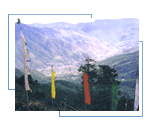
The workshop was designed to position Bhutan to protect and promote its own interests in the field of bioprospecting. WFED's Preston Scott stated that "Bhutan has a great advantage compared to many other countries because Bhutan already manages access to its biodiversity quite effectively. However, we also can share tools we have learned to assist Bhutan's biological resource managers think about how to position the country to protect its own rights and interests even more effectively." Preston added, "Properly managed, Bhutan can be positioned to strengthen the protection of its remarkable biological resources and rich traditional knowledge while also generating new benefits that can assist with Bhutan's special development priorities and plans." Lyonpo Kinzang Dorji, Bhutan's Minister of Agriculture in 2001, stated after the workshop: "I hope we can work together in the future in giving form and substance to our vision and policy on bioprospecting in Bhutan with an aim to conserve our rich biological resources and at the same time derive economic benefit by those involved in the conservation efforts." The workshop resulted from requests originally made by the Bhutanese after presentations by WFED in November 1998 in Lyon, France, for a global conference on 'biotrade' sponsored by the UN Conference on Trade and Development. While WFED has conducted similar workshops in North and South America, Europe, and throughout Africa, this was the first workshop WFED conducted in Asia. The WFED team included Executive Director Preston Scott; Thomas Minner (WFED Vice President); Dr. Lee Talbot (WFED Board Member and Professor of Environmental Science at George Mason University who also helped draft Bhutan's first Biodiversity Action Plan in 1998); John Varley (Chief Scientist and Director of the Yellowstone Center for Resources at Yellowstone National Park); Anita Varley (Director of Wilderness Operations at Yellowstone National Park); and Dr. Erich Veitenheimer (intellectual property rights specialist with the law firm Morgan, Lewis & Bockius LLP). 2003 - 2004 Activities: National Biodiversity Act In August 2003, WFED hosted Dr. Ugyen Tshewang, Program Director of Bhutan's National Biodiversity Center at its offices in Washington, DC for one week. The timing of his trip coincided with the passage of Bhutan's National Biodiversity Act. Endorsed by the 81st session of Bhutan's National Assembly, the Act "will implement legal, administrative and policy measures to regulate access to genetic resources of the country." While in Washington, Dr. Ugyen requested WFED begin writing draft regulations of the Act's six chapters for its implementation. Preston Scott, WFED's Executive Director, then accompanied Dr. Ugyen to Yellowstone National Park for meetings organized by WFED with park personnel focusing on issues related to benefit-sharing management. While in Yellowstone, Dr. Ugyen met with Dr. John Varley, Director of the Yellowstone Center for Resources (YCR), Dr. Wayne Brewster, YCR Deputy Director, various park resource managers, and Dr. Erich Veitenheimer of the Washington office of Morgan Lewis & Bockius. Dr. Veitenheimer, along with Dr. Varley, participated in the May 2001 WFED led ABS workshop held in Bhutan. This was Dr. Ugyen's first visit to Yellowstone and WFED arranged various tours of the park for him to learn firsthand how the most active scientific program (YCR) within the US National Park Service manages its biodiversity resources. In October 2003, as directed by Dr. Ugyen, WFED began drafting written regulations to implement Bhutan's new Biodiversity Act. This process involved researching various US and international regulatory models as well as extensive legal research and analysis to determine the best method for implementing the various subject areas of the Act. Draft written regulations were prepared for three of the four subject areas of the Act: Institutional Arrangements, Access to Genetic Resources and Benefit Sharing, and Plant Variety Protection. It was determined in consultation with Dr. Ugyen that regulations for the fourth component, Protection of Traditional Knowledge, would be deferred until 2004. Ultimately, WFED wrote and prepared an 86 page draft document (Biodiversity Rules of Bhutan, 2003) that translated the legal clauses of the Act into implemented regulations. The document also contained multiple permit application forms designed by WFED with accompanying guidelines and definitions as directed by the Act. In November 2003, WFED's Preston Scott and Yellowstone's Dr. John Varley traveled to Bhutan to present the draft regulations to stakeholders in a workshop organized by Dr. Ugyen. Over 30 attendees from various divisions of the Ministry of Agriculture of the Royal Government of Bhutan participated in the three day workshop held in Phuentsuling, Bhutan, next to the Indian border. WFED led an in-depth word-for-word review of the draft regulation document to make sure that all individual stakeholder needs were met and that the regulations would work appropriately in the unique Bhutanese context. Attendees suggested additions and modifications which were then incorporated in the text. These changes were meticulously reviewed until everyone understood and accepted the document. While in Bhutan, WFED additionally met with various governmental representatives and ministers renewing as well as building new relationships that will be essential to the ongoing development of the project. Finally, additional meetings were held with Dr. Ugyen and the National Biodiversity Center staff to finalize the text for the draft regulations and to discuss future project strategy. In 2004, WFED continued to write the six chapters of the rules and regulations that will enforce and clarify the Biodiversity Act of Bhutan. WFED planned and organized a trip to Bhutan with a team of scientists and policy makers from the Smithsonian Institution to Bhutan. The goal of the trip was to explore potential areas of scientific collaboration. World renowned spider scientist, Jonathon Coddington, was one of the Smithsonian scientists who participated in the trip. At the conclusion of this trip, WFED’s Mansir Petrie worked in Bhutan for an additional three months, stationed at the National Biodiversity Center, helping to prepare the center for future scientific collaboration projects and moving the Biodiversity Act’s Rules & Regulations closer to finality. In November, Mr. Petrie guided a scientific delegation from Western Kentucky University to Bhutan, exploring future areas of collaboration within the Ministry of Agriculture as well as traveling across the country experiencing, first-hand, the nation’s rich diversity of forests, altitudes, and climates.
About WFED : Services : Projects : Information Resources Last updated on:
|
||