 |

|

|
||||||
Bioprospecting for Peace in Russia 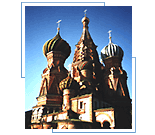
WFED is working with the US Government and Russian authorities to create new partnerships between private sector research firms and former Russian bioweapons scientists to prevent the proliferation of biological weapons from the former USSR. The project is believed to be the first time that bioprospecting benefit-sharing incentives have been applied in a peace and security context with global implications. Officially sponsored by the Initiatives for Proliferation Prevention of the US Department of Energy, the project aims to create new incentives for the redirection of Russian bioscience towards non-military commercial uses. Already, some former bioweapons labs in Russia are beginning to produce useful nonmilitary products such as HIV diagnostic and other healthcare kits. However, new partnerships must be created and markets must be expanded if the nonmilitary scenario is to prevail for the future. Project negotiations commenced in 1998, when Energy Department officials who noted WFED's work in Yellowstone asked WFED to help design a new project that would create incentives to minimize the risk of proliferation of Russian bioweapons science and to help redirect the science towards beneficial nonmilitary uses. In late 1998, WFED helped arrange US and Russian meetings in France to discuss the project aims. In September 1999, WFED's Executive Director Preston Scott was invited to participate in further discussions in Moscow and at one of the largest former bioweapons facilities located in Novosibirsk, Siberia. The Novosibirsk facility has been the subject of several prominent media reports as well as an important book published in 1999 by the former deputy director of the USSR's bioweapons program. WFED's project approval and initiation was announced by the Energy Department in July 2000 at a joint US-Russian scientific conference. Preston returned to Russia in October 2000 to work directly with the Russian partners in the project and to help them prepare for their negotiations with participating US bioscience companies. Center for Ecological Research and 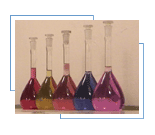
With the assistance of WFED and the U.S. Department of Energy (DOE), the Center for Ecological Research and BioResources Development (CERBRD) was created in December 2000. Located in Pushchino, Russia, the Center is comprised of the Institute of Biochemistry and Physiology of Microorganisms, the State Research Center for Applied Microbiology, the Research Center of Toxicology and Hygienic Regulation of Biopreparations, and the All-Russian Research Institute of Phytopathology. CERBRD is a non-profit entity that serves as a focal point for business (research and commercial firms) and Russian science. It represents an efficient institutional, multi-disciplinal mechanism that coordinates negotiations and contractual relationships between potential research partners, acts as the clearinghouse for information relating to biological resource data, provides project-directed financial support to participating institutes, and focuses resources and personnel on research activities that are aimed at generating value. CERBRD provides a means for attracting commercial investment in joint research projects in Russia as well as encouraging new areas of collaboration between Russian institutes and technology centers. The Center also opens up new opportunities for collaboration with environmentally important locations in Russia. CERBRD reduces transaction costs and other economic and administrative barriers to activities between participating Russian institutions and foreign research firms. The CERBRD concept institutionalizes the principle of economic sustainability from the initial phases of projects. Preston Scott, WFED's Executive Director, was instrumental in helping draft the organizing documents for the new Center, which included obtaining approvals from the relevant Russian authorities as well as creating a structure that would facilitate cooperation among multiple Biopreparat Institutes for joint research activities with U.S. interests for the very first time. WFED has been asked by the Russians to serve as "Special Advisor" to the newly chartered Center and its all-Russian Board of Directors. In this capacity, WFED will continue to work closely with the Center to assist in the "swords into plowshares" conversion of these former bioweapons facilities into peaceful commercial entities using microbiological science to accomplish broader, peacekeeping goals. See also: Bioprospectors: Tell the Russians Were Coming
About WFED : Services : Projects : Information Resources Last updated on:
|
||||||||
