|

|
|
|
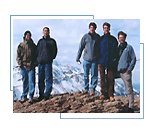
"I learned about the efforts involved in wildlife management and the importance of preserving ecosystems. The concept which has most affected me is that of the interconnectedness of species and the fragility of ecosystems when influenced by humans." Every spring, WFED's Nature Conservation in Action (NCIA) program leads an environmental education trip to Yellowstone National Park. Since 2000, this program has guided seniors from the Washington, D.C. area to our nation's first national park. In May of 2002, under the leadership of WFED's Mansir Petrie, the program began its partnership with St. Stephen's & St. Agnes School in Alexandria, Virginia. These trips team high school seniors who show an interest in the practical side of environmental conservation with Yellowstone Park biologists. During the two weeks of the program, students participate in fieldwork projects at Yellowstone Lake that conserve the park's native population of cutthroat trout. The lake trout, a larger and more robust fish, was introduced illegally into the park in the early 1990's and threatens the survival of the native cutthroat trout. Each student is paired with a park biologist who serves as a mentor. Throughout the history of the program students have repaired cutthroat trout monitoring stations; measured, weighed, and took scale samples from cutthroat trout specimens; gathered trout egg samples for the State of Montana spawning programs; participated in electro-fishing; repaired, organized, and set gill-nets; and removed lake trout from these nets. Outside of seeing conservation in action, these students are also exposed to lectures, workshops and fieldtrips related to the management of other important species within the park, such as bears and wolves. This program would not be possible without the patience and support of NPS staff. WFED would like to thank the following NPS staff for making this project a success: Todd Koel, Pat Bigelow, Dan Mahony, Barbara Rowdon, John Varley, Liz Cleveland, Kerry Gunther, and Becky Anthony. We send particular appreciation to the following NPS Fisheries staff for being student mentors: Brian Ertel, Don Wethington, Davina White, Amber Steed, and Chris Dixon. In May 2000, four seniors from the Maret School in Washington traveled to Yellowstone to map some of the park's hot springs never before systematically identified and studied. Meredith Kirschner, Cloe Thompson, Isabelle Liberman, and Christina Scott worked with Yellowstone's Geographic Information Systems (GIS) experts to help set up simple ways that high school and college student volunteers could do much of the field work to support Yellowstone's ambitious effort to map the park's 10,000 hot springs, geysers, fumaroles, and boiling mud pots. While many of the park's most charismatic thermal features (such as Old Faithful) are well known to visitors and are national icons, the overwhelming majority of the park's 10,000 thermal features have never before been identified and mapped. Such environmental data is critical to the park's ongoing management of the thermal features, as well as to visiting researchers who are interested in discovering new forms of life in specific types of extreme environments. The Maret students' project with Yellowstone was facilitated by WFED as part of WFED's ongoing collaborative environmental education and stewardship work with the park. Meredith, Chloe, Isabelle, and Christina mapped approximately 75 hot springs never before identified throughout the park stretching from the Lamar Valley in the northern range to within a mile of Old Faithful. The students used advanced satellite-linked GIS mapping equipment, together with more basic instruments to measure and record each hot spring's temperature, pH, and conductivity. Digital photographic images of each hot spring also were recorded to provide a visual baseline for future researchers. The Maret School seniors' volunteer work at Yellowstone was the first student-focused project WFED has facilitated at the park. Maret School students have participated in three WFED environmental learning excursions to Costa Rica since 1995. In May 2002, four seniors from St. Stephen's & St. Agnes School in Alexandria, Virginia participated in the NCIA program led by WFED's Mansir Petrie - Ian Coleman, Taylor Lankford, Patrick Ledbetter, and Kal Pupos. For eleven days, the students worked alongside National Park Service fishery biologists to conserve Yellowstone's endangered cutthroat trout. The seniors participated in hands-on conservation projects. They put on NPS wading gear and worked in the cold mountain streams to replace broken mechanisms designed to count cutthroat trout as they spawn. In another remote stream within the park, the students worked with the biologists to send mild electrical shocks through the water in order to harmlessly catch, measure, weigh, and tag cutthroats. During their second week, the students boarded an NPS fishing boat and learned how NPS sets gill nets in order to reduce the invasive lake trout population. When the nets were full the following day, the students helped the biologists pull in the gill nets and remove the lake trout. For all of the students, working with conservation professionals on an important and pressing issue such as cutthroat trout conservation was a new experience. For some, this trip created a new awareness of, and, appreciation for, conservation careers; for others, their previous interest in nature conservation was strongly reinforced. One student stated that because of his experience in the program, he now wants to purse a career in the park service after he is finished working in the air force. Another student reported that he was now intent on taking conservation biology classes when he enrolled at the University of Virginia the following fall. When the students were not working, the group explored the park's geysers and trails. One evening the group sighted grizzly bears foraging for food with their cubs and a pack of wolves around an elk carcass. In May 2003, participating seniors in WFED's NCIA program from St. Stephen's & St. Agnes School in Alexandria, Virginia included Cheryl Gnerlich, Tim Gray, Charlotte Petty, Laura Sauls, and Lori Simpers. They worked alongside NPS biologists for seven days as they studied whirling disease (a major threat to cutthroat trout), as well as the effects of water drainage on spawning cutthroats in one of the park's northern creeks (Reese Creek). The students also camped at a backcountry field station to count spawning cutthroats and make needed repairs. The NCIA program developed in several ways in 2003. The students had more time with their NPS mentors in the field. A couple students learned to operate the NPS fishery boat, one senior logged and analyzed data, while a couple others traveled to monitoring stations. The students also were able to hear park professionals talk about their careers. Kerry Gunther, a bear wildlife biologist, spoke about the history of bear conservation in the park. John Varley, the Director of the Yellowstone Center for Resources, talked about the natural history of cutthroat trout and their changing role in the park ecosystem. The students left the park with a personal experience of the everyday challenges and victories involved in the management of one of the world's great national parks. Quotes from 2003 participants: "I really enjoyed working with my mentor." "I realize with a better understanding that if the lake trout were to become the dominant species in the Yellowstone Lake environment, then at least 40 species that depend on cutthroat trout would be affected. This was something I already knew, but to actually work firsthand on these issues made them much more real." "I really enjoyed the in-car quizzes because they focused the information we gathered in the field." "I really enjoyed the variety of activities, the balance between being an employee and working, and being a tourist and sightseeing was great." "The best part was reading the information packet and then interacting with the biologists to see how they go about handling the situation. It was pretty much seeing how everything comes together in the field that I enjoyed learning the most." "The trip was one of those experiences I will never forget because it was not only fun, but also enriching." "My favorite part of the trip was hiking through the snow to Clear Creek to spend the night, handle and sample trout, and watch the fish swim upstream to spawn."
About WFED : Services : Projects : Information Resources Last updated on:
|
||