 |

|

|
||||||
African Bioprospecting Seminars Applaud WFED's Approach In the summer of 1999, the Global Bioscience Development Institute (GBDI) invited WFED to design and implement bioprospecting seminars for a series of training courses in Africa. In August 1999, WFED's Preston Scott and Leif Christoffersen facilitated a five-day training seminar on bioprospecting contract negotiations in Nairobi, Kenya. Mr. Scott later returned to Africa to lead another seminar in Ibadan, Nigeria in March 2000 and in Cape Town, South Africa, in April 2000. In August 2000, Preston Scott and Leif Christoffersen conducted a seminar in Gaborone, Botswana. Additional seminars were also conducted by Preston Scott in Cotonou, Benin in May 2001 and Dar es Salaam, Tanzania in July 2001. Kenya - Drafting and Negotiating Conservation-Based Bioprospecting Agreements The Nairobi course was hosted by GBDI and the International Centre for Insect Physiology and Ecology, and was sponsored by the US Agency for International Development (USAID). Attended by a select group of participants mainly from Kenya, Tanzania, and Uganda, the course focused on the mechanics of drafting and negotiating conservation-based bioprospecting agreements. The participant evaluations reflected unanimous praise for WFED's course. Follow up discussions between WFED and the Kenyan Wildlife Service and the National Centre for Science and Technology may lead to conservation-based bioprospecting projects in East Africa. 
Nigeria - Negotiating Benefit-Sharing Agreements In March 2000, Nigeria's conservation-conscious Institute for Tropical Agriculture in Ibadan hosted the second GBDI-organized workshop on negotiating benefit-sharing agreements. Most of the 50 participants were from countries in West Africa ranging from the Gambia to Cameroon. This was the second course on techniques for negotiating bioprospecting agreements that WFED taught in Africa, with a specialized focus on technical legal issues. The Nigerian workshop sought to promote greater technical understanding of new resource conservation and development approaches throughout Africa - a universally recognized need. South Africa - Bioprospecting Conservation Practices and Intellectual Property Rights Issues
Participants discussed how natural products development can promote conservation goals and how local stakeholders such as farmers and traditional healers can be included in benefit-sharing agreements to improve their quality of life, promote overall economic growth and protect local resources. Botswana - Southern African Biodiversity, Biotechnology, and Law Training In August 2000, WFED's Leif Christoffersen and Preston Scott traveled to Gabarone, Botswana to serve as members of the international faculty in GBDI's four-week Southern African Biodiversity, Biotechnology, and Law Training Course. Sixty-five participants attended the course from 12 member countries of the Southern African region.
Preston's presentation gave the participants a detailed analysis of the Cooperative Research and Development Agreement between Yellowstone National Park and the Diversa Corporation (the first bioprospecting agreement in the United States). WFED's presentations were very well received and led to many inquiries about WFED assistance from many delegates from throughout the Southern African region. Benin - Benefit-Sharing Tools in French-speaking Africa
Workshop participants from throughout Africa have praised WFED's practical approach to negotiation of bioprospecting benefit-sharing agreements. Preston explained during an interview on national radio in Benin that the workshops are designed to develop and share the tools needed to promote meaningful problem-solving negotiations concerning access and use of biodiversity in Africa. Tanzania - Benefit-Sharing Tools in East and Central Africa
About WFED : Services : Projects : Information Resources Last updated on:
|
||||||||

 WFED was invited to Cape Town, South Africa, in April 2000, to lead special sessions on bioprospecting conservation practices and intellectual property rights issues at the invitation of South Africa's Agricultural Research Council (ARC). The conference, entitled "Agribusiness in Sustainable Natural African Plant Products," was sponsored by USAID, ARC, the Herb Research Foundation, and Purdue University. The conference brought together farmers, traditional healers, natural product development companies, government officials and experts on biodiversity conservation and use issues. Approximately 150 participants from more than 15 countries in Africa, Europe, and the Americas attended.
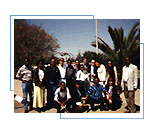 Leif gave a presentation that included information about market opportunities for bioprospecting activities around the world, with focused case studies on Norway and Madagascar. He also led two working group sessions in which participants developed and presented diagrams outlining the principal players engaged in bioprospecting activities in each of their countries. Leif also facilitated participant discussions on ways to develop and implement country-specific and regional bioprospecting activities.
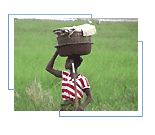 WFED's Preston Scott traveled in May 2001 to Cotonou, Benin, to serve as a member of the international faculty in the Global Biodiversity Institute's (GBDI) Biodiversity, Biotechnology, and Law Training Course for French-speaking African countries. The course was attended by approximately 50 participants from throughout West Africa. Preston joined Jorge Cabrera and Nicolas Mateo from Costa Rica, Beatrice Chater from FIELD in London, and John Varley from Yellowstone National Park in a series of presentations concerning the negotiation of bioprospecting benefit-sharing agreements. Other workshop topics were taught by faculty from the National Cancer Institute, the World Intellectual Property Organization, and other cooperating organizations.
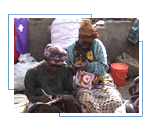 In July 2001, WFED's Preston Scott traveled to Dar es Salaam, Tanzania, to serve as a member of the international faculty in the Global Biodiversity Institute's (GBDI) Biodiversity, Biotechnology, and Law Training Course for East and Central African countries. Approximately 50 participants attended the weeklong seminar and were very interested in WFED's focus on working with national parks and other conservation areas. At the end of the workshop, Preston urged decision makers to explore development and implementation of pilot projects that provide important tangible economic and environmental benefits for more local participants.